)

The song of the month may be "Happy together", but this month, two of the market’s biggest players are anything but. Equities and bonds are telling completely different stories, creating a puzzling and contradictory environment for every investor.
In our Market at a Glance, we dive into this fascinating disagreement to explore which side has the more convincing argument and what it means for your portfolio.
Then, in the Demystification Room, we turn our attention to another major headline: the Initial Public Offering, or IPO, of SpaceX. With news of a blockbuster deal capturing everyone’s attention, we examine whether it is wise to jump on the bandwagon on day one.
Finally, with our expanding pension offering, we want to make sure you are "Happy together" with your retirement planning for the long term.
Enjoy the read.
Table of Contents
The market at a glance: Happy together
Song of the month: “Happy together" by The turtles
We all know this type of couple: one an eternal optimist, the other a hardened pessimist. Two people whose outlooks on life are fundamentally at odds, and yet, they end up together, often for the long haul. You know exactly what I mean. Personally, I find them fascinating. There’s something both touching and captivating about their dynamic. How do such opposites manage to form a coherent, and ultimately happy, whole?
With that in mind, I dedicate this market commentary to them, set, appropriately, to the tune of "Happy together" by The Turtles (1967).
A similar duo exists in the investment world: equity markets, the perennial optimists, and bond markets, the eternal worriers. Yet they are simply two sides of the same coin, the financing of the real economy. If you think I’m exaggerating, just walk into any investment committee meeting. It won’t take you long to spot who runs fixed income and who leads equities.
This month, however, the cliché feels entirely justified, their reactions to the same economic data and geopolitical backdrop could hardly be more different.
Key takeaways
Like an old married couple, equity and bond markets are not seeing the future through the same lens this month.
Equities are brimming with optimism and posting solid gains.
Bonds, by contrast, are fretting about a return of inflation and are starting to wobble. So, who should we believe?
Elsewhere, oil remains above USD 100 per barrel, gold is faltering, and cryptocurrencies continue to zigzag.
What happened with equities
Let’s start with the facts. On one side, we have a prolonged conflict in the Middle East, oil back above USD 100, and rising inflation figures. On the other, a strong earnings season nearing its end, showing companies in robust health, and tentative signs of renewed dialogue among major global powers.
A classic case of mixed signals, open to interpretation.
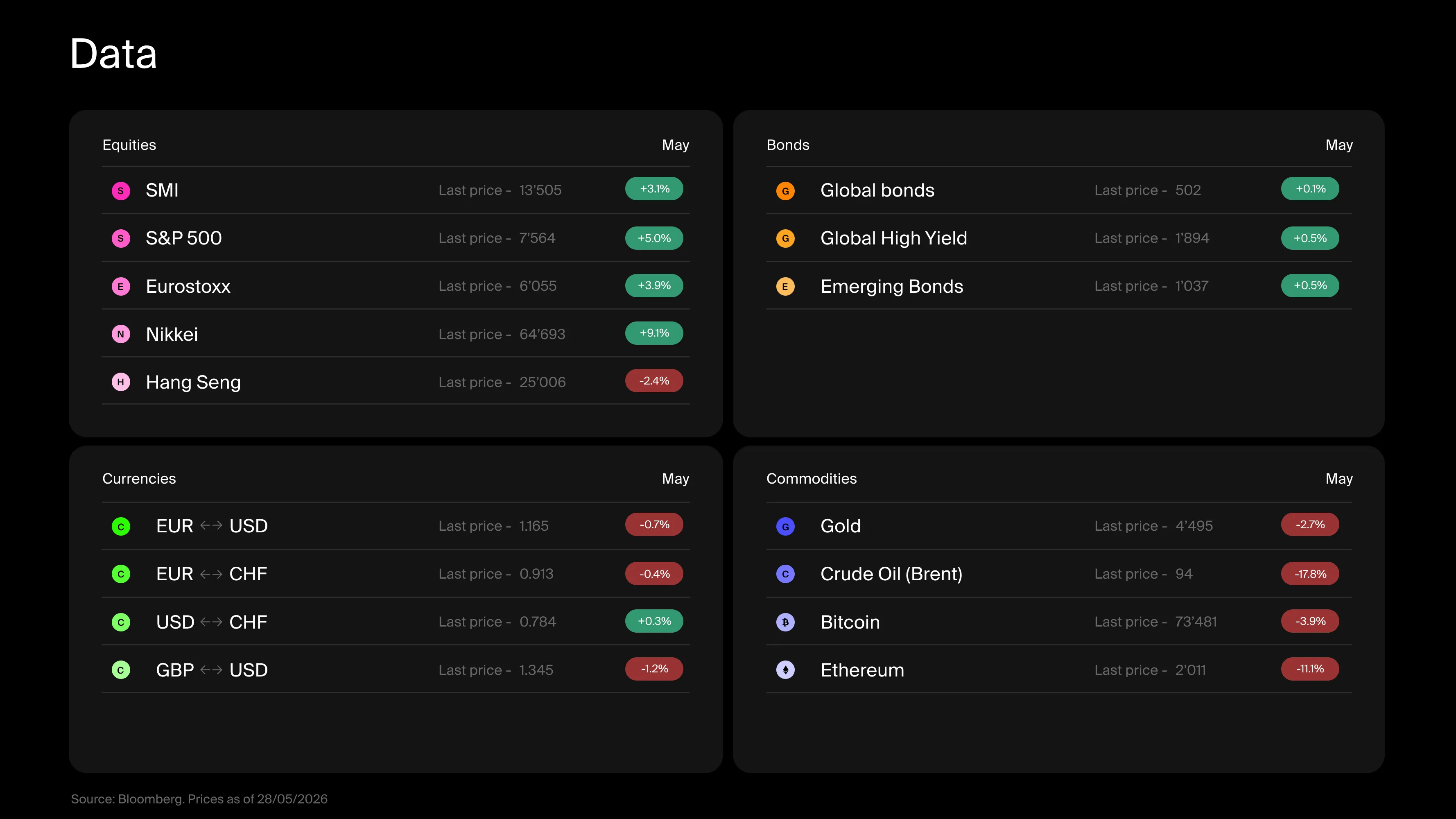
Equity markets have made their choice: they see the glass as half full. Evidence? The S&P 500 is up 5.0% month-to-date, and the SMI has gained 3.1%. From their perspective, the inflation and growth shock stemming from tensions in Iran remains manageable.
Manageable, first, because the situation could eventually normalize. And second, because the productivity gains promised by AI over the medium to long term appear far more significant. Enough, in their view, to put near-term concerns into perspective.
Still, this optimism deserves nuance. Beneath the strong headline performance, dispersion within indices remains significant. Investors are becoming increasingly selective, favoring large-cap tech names and geographies perceived, rightly or wrongly, as safer. In short: optimistic, but discerning.
What happened with bonds
Bond markets, on the other hand, are firmly focused on the half-empty glass. It has been a while since we’ve seen such a broad-based rise in long-term yields.
In Switzerland, the 10-year yield has nearly doubled in the space of a month. In the United States, the 10-year came close to 5%. And the move is global.
The interpretation is straightforward: expectations of higher inflation, an energy shock, and persistent structural deficits. Investors are now demanding a higher premium to hold long-dated bonds.
Where equities say, “Growth is holding up, there’s no need to worry, brighter days lie ahead,” bond markets respond:
“Perhaps growth will prove resilient, but you’re overlooking inflation… and the massive debt burden we’re sitting on.”
What happened with commodities, currencies, and digital assets
Some of the divergences observed in rate markets are also reflected in foreign exchange, with tangible implications for Swiss investors. While the Swiss franc weakened against both the dollar and the euro in March, it reversed course and appreciated in April.
In commodities, oil remains the key variable drawing everyone’s attention. It has the potential to shape the course of events, both economic, particularly through its impact on inflation, and geopolitical, by determining which countries are best positioned to cope with a potential supply shock.
It is also worth examining the behavior of gold and digital assets. The former is showing concerning signs of fatigue. As we highlighted last month, gold tends to rally in anticipation of risk, but not necessarily once that risk materialises. After declining in March, it failed to rebound in April, despite what appears, on paper, to be a supportive environment. This may raise doubts among investors, especially those who entered the market late, at record levels.
Digital assets, for their part, are still struggling to recover from their recent correction, while attempting to reassert their value proposition in the current environment. Another potential relative-value trade?
What should investors take away?
First, divergences between equity and bond markets are more the rule than the exception. They reflect a market system digesting and interpreting the same reality through different lenses.
Second, such configurations do not necessarily signal an imminent crisis. Historically, periods where yields rise alongside equities have more often been followed by continued equity gains and a subsequent decline in yields—rather than an equity market reversal.
Finally, there is no need to pick a side. If both asset classes coexist within a portfolio, it is for a good reason, the same reason optimists and pessimists often form enduring partnerships: they are complementary, united by a shared purpose, and, more often than not, happy together.
)
Demystification room: Initial Public Offering
The news of past few weeks have been overflowing with informations and updates about Elon Musk’s SpaceX Initial Public Offering, or IPO in short.
Initial Public Offerings is the process where firms go from being privately owned to being publicly tradable, meaning that a share of the company’s ownership will be passed on to shareholders, bringing both opportunities (cash inflows) and challenges (less control) to the management.
The IPO process is a length administrative procedure, often spanning over multiple months, requiring all sorts of filings and procedures, ranging from board approval, to due diligence, over to the determination of the initial offering price.
What differentiates this IPO from all others in history, is the sheer volume of it. According to first reports, SpaceX expects to raise between 70 and 80 billion dollars, which would value the firm at around 1.75 trillion dollars - making Elon Musk’s worlds first trillionaire.
But is it worth hopping on the bandwagon and to be the very first to buy some shares of a newly public company?
IPOs are prone to the infamous “first day effect”. Especially with highly publicised IPOs and renown firm, prices and demand spike on the first trading, before correcting later.
Indeed, when analyzing a sample of 1247 IPOs over the period May 2025 to May 2026, even if median returns are positive, not only are they steadily decreasing over time, but an astonishing share of those IPOs show negative returns (meaning that there is a very high chance to lose money on an IPO, but that the survivors show high returns).
This leads us to the answer of the above stated question: no, investing in a firm right on their first trading day is not worth it, as most firms then observe a correction of the initial hype priced into the stock. Even if returns slightly increase over the first week, they drop again right after. Even if average returns increase slightly, we see that both median decreases and the share of negative
A better strategy would be to conduct a short assessment of the firm’s overall financial health and purpose to decided if it is really worth investing on a long-term basis, rather than based on a short-lived market hype. In a nutshell, an IPO is not a magical solution. It’s better to rely on your own due diligence rather than the headlines if you want to tilt the odds in your favor - as always in finance, predicting the exact outcome is incredibly difficult.
Your future, together
The enduring partnership of the optimist and the pessimist, shows that different outlooks can work together for a common goal. The same is true for your financial future. Whether you see the glass half-full or half-empty, planning for retirement is the ultimate shared journey.
At Alpian, we believe that no matter your investment philosophy, your pension is a cornerstone of a secure future. To help every type of investor build that security, we are thrilled to announce that our pension offering is expanding.
Already available :
Crypto for Pillar 3a: For those looking to add a forward-looking edge to their portfolio, we’re introducing cryptocurrencies as a new strategic focus for your retirement savings.
Coming soon:
Alpian Vested Benefit Account: A modern solution designed to help you seamlessly manage your pension assets between professional chapters.
Stay tuned for more details. Because when it comes to your financial future, we want you to be "Happy together" with your plan.
Disclaimer : Investments involve risks, including the possible loss of invested capital. The value of investments can fluctuate and there is no guarantee of making profits or avoiding losses. Diversification does not ensure a profit or protect against a loss. Potential investors should consult a qualified financial advisor before making any investment decisions. Please read the full risk warnings and other relevant documents on our website before investing.


)

)